Wednesday, August 26, 2015


http://www.haaretz.com/polopoly_fs/1.667835.1437894575!/image/152856090.jpg_gen/derivatives/landscape_2048X1536/152856090.jpg?1439292792092

Jesus in Jerusalem: A guide

On our tour (April 15-May 16, 2016) we will be visiting a good number of the churches identified here. This is not actually a "guide" to Jesus in Jerusalem. Rather, the map of Jerusalem in this piece from HaAretz shows the location of churches marking the spots where the history of Jesus in Jerusalem unfolded. Of course the accuracy of the locations is disputed. As is typical, churches were built to commemorate events, the locations of which were based on tradition. Even so, the church at each site doesn't so much identify the location, as it invites pilgrims, both imaginatively and prayerfully, to enter the story it commemorates .

From the introduction to the page: "Once there was only a cave, or a scarred piece of bedrock. Across the generations, the faithful passed on the stories of Jesus, and pointed at the places in Jerusalem where a miracle, a teaching or an event was said to have happened some 2,000 years ago. And over the eons, sometimes a mere few centuries after the event, churches were erected to mark the sites where Jesus is believed to have worked his wonders. Today these shrines, restored to glory, are destinations for people all over the world."

On the map, click on the yellow church icons to open up a picture and explanation of the spot.

Tuesday, June 30, 2015

1913: Seeds of Conflict

Tonight (June 30, 2015) PBS broadcasts what I think will be a very interesting documentary.


From the PBS webpage: "Most observers consider the Balfour Declaration and Mandate period of the 1920s as the origin of today’s Israeli-Palestinian conflict. Breaking new ground, 1913: SEEDS OF CONFLICT, a one-hour documentary directed by filmmaker Ben Loeterman, explores the divergent social forces growing in Palestine before World War I, when Arabs and Jews co-existed in harmony as Ottomans, each yearning for a land to call their own."

CLICK HERE to go to the PBS web page.

View the trailer.

More from the website:

"Government documents, newspaper accounts, and personal letters in five languages from the Turkish state archives provide new and fascinating insights into dramatic events that took place in Palestine just before the outbreak of World War I.

1913 Palestine is a multi-lingual, multi-cultural society. Muslims, Jews and Christians coexist in relative harmony and often gather together in the coffeehouses of Jerusalem. It is a time before Jerusalem’s Old City is segregated into separate ‘quarters’ for various groups. But after European Jewish migrants arrive, Ruhi al-Khalidi, Jerusalem’s representative to the Ottoman Parliament in

Istanbul, voices growing concerns about what he sees as their secret agenda to build a state. So does Albert Antebi, an Arab-speaking Sephardic Jew known as the Jewish “pasha,” who embraces economic and cultural Zionism, but fears the consequences of a Zionist land grab.

Meanwhile, Arthur Ruppin arrives from Germany to be the Zionist’s land agent and Khalil Sakakini returns from a trip to America filled with pride and optimism of a new Palestinian Arab identity. In 1913, growing tensions erupt into violence in the vineyard just outside Rehovot, leaving an Arab and Jew dead, and sowing the seeds for a century of conflict.

Read more »

Tuesday, June 16, 2015

The Enright Files: Israeli-Palestinian Relations

A confrontation between an Israeli soldier and a Palestinian during a demonstration against Israeli settlements in the village of Turmus Aya near the West Bank city of Ramallah, Wednesday, Dec. 10, 2014.

Now that next Spring's tour dates have been set (April 25-May 16, 2015), we're ready to prepare ourselves for what we're about to experience. The tour's title, "Ancient Stones, Living Stones," suggests that participants will enter the ancient world of biblical sites and stories and will visit with some of the people who live, work, and long for peace in the land. This CBC Radio "Ideas" program from May 4, 2015, takes us into the Israeli-Palestinian conflict, which serves as one avenue into the world of the living stones. Michael Enright interviews two Jewish Israeli journalists who offer their rather different perspectives.

"In the wake of a highly contentious election in March, many were wondering about the future of Israeli-Palestinian relations. It's an issue that Israel's oldest daily newspaper, Haaretz, has long grappled with.  In this episode, Michael Enright revisits recent conversations with two of Haaretz's most influential columnists: Ari Shavit, the author of the acclaimed book, My Promised Land: The Triumph and Tragedy of Israel, and the award-winning, but highly polarizing Gideon Levy."

Listening to the full 54 minute program will be well worth your while. CLICK HERE TO LISTEN

Related websites:

Haaretz

Ari Shavit
Gideon Levy

Monday, March 2, 2015

Alain Epp Weaver's recent book is the subject of an extensive discussion at the journal Syndicate, at which four authors will engage with Epp Weaver's book. Readers interested in this theopolitical conversation will be richly rewarded. Check back every few days for new essays. After the online versions have been posted, the essays will only be available in the print edition. The editor begins his introduction this way:

http://syndicatetheology.s3.amazonaws.com/syndicatetheology/wp-content/uploads/Weaver.jpg

"Talking about Palestinian-Israeli affairs is very uncomfortable. It is a practical matter of grave significance for contemporary foreign affairs and a historical malaise of maddening perplexity; the lack of peace has tragically grave consequences as we all learned this last July when escalating violence between Israel and Hamas in Gaza led to the deaths of over 2000 Palestinians in Gaza and 71 Israelis. The historical complexity of the political reality is redoubled when the issues therein are discussed as political-theological matters, mostly because political theology itself is inherently awkward. Political theology forces us to discuss topics that are gauche, uncouth, and imprudent: violence, sovereignty, God, rights, and money. And so, one can be forgiven for thinking that, if it is taken up as a political-theological matter, any further discussion of the distance between Jewish, Christian, and Muslim perspectives (not to mention the multiplicities therein) about how to organize and arrange—that is, to map—their collective futures, only promises to deepen the distrust, pain, and dispossession."

Click here to read more

Tuesday, December 23, 2014

2016 Dates: Planning Begins!!

Planning is underway for the 2016 tour. Although the itinerary has not yet been set, the dates are more or less firm. I hear from my agent in Jerusalem that in spite of the political challenges in the region, study and pilgrimage tours are still flourishing.

I look forward to leading my ninth tour to the region. During the next year I will be posting a variety of items of interest for participants. I will post links to articles and websites. Some may be items of archaeological interest, and some will have a theological and/or political bent. You are welcome to peruse past posts, although be aware that some of links that I refer to may no longer be active.

Please contact me if you are interested in participating (for my contact information, please go to the tour website at the link on the right side of this page). Although it's not required, you  may participate in the tour for academic credit (undergraduate or graduate).

Sunday, March 23, 2014

Pilgrims, Students, Tourists

I tell groups that they will experience their participation in a study tour in at least three ways: as pilgrims, students, and tourists. 


Tourists come to gather experiences, photos, and souvenirs. As tourists we are consumers. Of course there are now special ways of re-configuring tourism, like "eco-tourism" or "tourism with a purpose," by which is meant doing volunteer work for a time before savoring some beach time. Being a tourist is great fun. And it has its place. I love being a tourist. I have no responsibilities. And I escape the hectic life at home in exchange for a completely different kind of hectic. And that can be rejuvenating for a time.

On a study tour like this one, we find ourselves immersed in learning. We become students for a large part of every day. We visit ancient historical sites. We listen to our guide explain the historical context of the site. We hear the stories of local people, Jews, Christians, and Muslims. We ask questions and hope to learn from their experience of living in this troubled land.

And we are pilgrims who come prayerfully. We hope to enter the biblical story not only in our imaginations, but also with our feet firmly on the ground. I don't always understand the pilgrim ways of some of the people I see. I can't kiss the stones in the Church of the Holy Sepulchre, as some do. Yet I want to enter the story through the land and through its people today. The land, as Saint Jerome put it, can be a "fifth gospel." But it's not holy just because Jesus or Elijah walked here. What's holy is what happens, wherever we happen to find ourselves, as we are transformed to be agents of peace and reconciliation, in genuine community with others (even enemies).


Somewhere I received this quote about being a pilgrim: "There is a reason why the pilgrim’s journey involves going somewhere else. In order to experience transformation, the pilgrim must become vulnerable—he must expand his edges, crossing borders into new and unfamiliar territory. When the pilgrim journeys to a place beyond what he calls “home,” his senses are heightened, his vulnerabilities are brought to the surface and his perceptions are tested. In allowing these different parts of himself to come to the surface, he is able to be fully present in his journey amidst the discomfort and uncertainty, the mystery and the beauty." - From "Pilgrim Principles" by Lacy Clark Ellman, founder of A Sacred Journey Blog

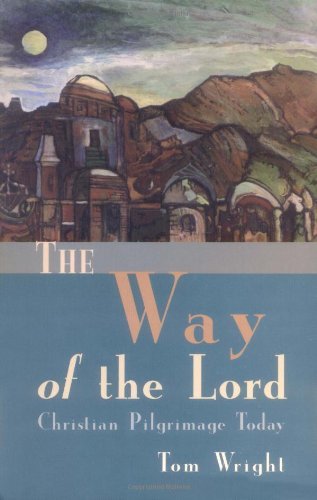
One of the best resources on Christian pilgrimage to the land of the Bible is Tom Wright's book The Way of the Lord: Christian Pilgrimage Today (Grand Rapids: Eerdmans, 1999). 


Here is the publisher's blurb for the book: "The Way of the Lord is a book to be read with Christian pilgrimage in mind, whether one is traveling to the Holy Land physically or merely in heart and mind. Tom Wright, a world-renowned expert on the New Testament and the life of Jesus, offers a guide to pilgrimage that also serves as an inspirational introduction to the Christian faith. / Wright explores all the sites that travelers usually visit on a tour of the Holy Land, explaining not only what is to be seen but also the context of faith that makes these sites, and the events associated with them, famous around the world. By weaving together Old and New Testament stories, poetry, and original insights, Wright helps readers enter imaginatively into each scene. He also sprinkles his narratives with reflections on the nature of pilgrimage generally and with discussion of vital contemporary issues related to the Holy Land.  Vividly evoking the sights, sounds, and smells of the Holy Land, The Way of the Lord is ideal for both individual and small-group study, for anyone planning a pilgrimage or for those just setting out on the spiritual journey of the Christian life."

One reviewer on the amazon.com website offers a few perceptive comments on pilgrimage, and on the book: Gregory of Nyssa went out of his way to criticize the practice [of pilgrimage], arguing that it is important to be close to God and one's neighbors and that pilgrimage made no contribution to accomplishing either imperative. And in more recent times, C. S. Lewis asserted, "The significance of the incarnation is not that God is a god of one place to the exclusion of others; it is that he is a god of all places, active in his world . . . God is to be found especially in people; namely those in need and in the gathered community of the Church . . . It follows that to set off on a journey to grow nearer to Christ is at best a complex matter. It might be that the true search is among those in need . . ." For the ardent pilgrim, Lewis commends the words of Matthew 28.6: "He is not here; he is risen." There is a certain logic to Lewis's position, but at the same time, it misses an important point. Pilgrimage is not about going to a particular place to find God. It is about putting ourselves in a particular place so that God can find us. For people who struggle with the concept of pilgrimage and who are inclined to side with Gregory or Lewis, Tom Wright's brief, readable work on pilgrimage will be a welcome guide. Former Dean of Lichfield Cathedral in Staffordshire, England, and the new Canon Theologian at Westminster Abbey, Wright grew up in the evangelical tradition. He heard little or nothing about pilgrimage early in his life and his first exposure to the practice left him with doubts not unlike those expressed by Lewis. But much to his surprise, he discovered that "one can learn to discover the presence of God not only in the world, but through the world." This growing realization prompted him to write this sage little work that not only serves as an introduction to the practice of pilgrimage but is also, by design, "a refresher course, from an unusual angle, on what might be called `Christian basics'." Using locations in the Holy Land where Jesus walked, talked, and healed, Wright takes the reader on a virtual pilgrimage, combining biblical scholarship with catechesis and inspirational challenge. But Wright is never facile or dogmatic. His closing paragraph provides a taste of the rest: "We do not go on pilgrimage, then, because we have the answers and want to impose them. That would make us crusaders, not pilgrims; the world has had enough of that, and I dare say God has had enough of that. We go on the pilgrim way, we follow the way of the Lord, because he himself is the way - and, as he said himself, the truth and the life as well. We go to meet him afresh, to share his agony, and to pray and work for the victory he won on the cross to be implemented, and for his way to be followed, in Israel and Palestine, in our own countries and in the whole world."

Saturday, March 22, 2014

Qumran & The Dead Sea Scrolls


Our first stop on May 6 will be in Qumran, the site where the Dead Sea Scrolls were discovered by Palestinian shepherds. 

"The Dead Sea Scrolls have been called the greatest manuscript find of all time. Discovered between 1947 and 1956, the Dead Sea Scrolls comprise some 800 documents but in many tens of thousands of fragments. The Scrolls date from around 250 B.C. to 68 A.D. and were written in Hebrew, Aramaic and Greek; they contain Biblical and apocryphal works, prayers and legal texts and sectarian documents" (Biblical Archaeology Society).


Photo source

Begin by taking a look: view the 360 degree panorama or here. The Bible Places website also provides a visual orientation along with an overview of various aspects of the Qumran site. There  you will find a short list of related websites, including, for example, links to The Shrine of the Book (which we will be visiting) and its many resources, including an Interactive Virtual Tour, the Library of Congress Dead Sea Scrolls page (Washington, DC), and many others. For photos of the various caves, click here. 

One of the best websites for information about the Dead Sea Scrolls is the Biblical Archaeology Society's "Bible History Daily" page. Click on the various links on that page to read about the history and controversies surrounding the discovery of the scrolls. For example:

Have a look also at the following:

Wednesday, March 19, 2014

PETRA: UNESCO World Heritage Site


Petra, one of our first stops in Jordan, is a UNESCO World Heritage Site. 

We'll have a full day of exploring with an expert Jordanian guide. We expect to be out in the sun more or less all day, which does wonders for resetting the body's clock.

One website I saw recently said this about preparing for a visit to Jordan: "The best advice I heard before going to Jordan was 'don’t read anything about it.' A friend wanted me to be surprised. 'Especially before you go to Petra, don’t read anything.'" I agree that you shouldn't read anything if all you want is to be surprised by everything you see. I think, however, that the best visit is done by preparing ahead of time, immersing yourself in the experience during your visit, and then reflecting and doing more reading after returning.

The website Visit Jordan has a good page on Petra. "Often described as the eighth wonder of the ancient world, is without a doubt Jordan’s most valuable treasure and greatest tourist attraction. It is a vast, unique city, carved into the sheer rock face by the Nabataeans, an industrious Arab people who settled here more than 2000 years ago, turning it into an important junction for the silk, spice and other trade routes that linked China, India and southern Arabia with Egypt, Syria, Greece and Rome."

The links on the left side of that page offer you entry into pages on history & culture, religion and faith, fun and adventure.


The Bible Places website has a good description along with a list of related websites. Of course Wikipedia will also provide a good general overview and photos.

Better yet, peruse these resources:


While in Petra we'll stay at the delightful Taybet Zaman Hotel, which is a restored 19th century Jordanian village.

Petra is a magical place. You will likely be drawn in by skillful Bedu children selling colourful jewelry.


But don't become distracted. Keep your eyes open for that unexpected sight.


Tuesday, March 18, 2014

Halva Kingdom: One of My First Stops on Our Free Day in Jerusalem!


I have a long list of things to do on our free day in Jerusalem (check out the link on the right side of this page). Since our free day is a Friday this year, it will be important to get to the Machane Yehuda market on Jaffa Road in West Jerusalem fairly early. I expect it to be crowded. I will go straight to Halva Kingdom and I will buy more than I did last time. Coffee Halva is my first pick.

From the website:

"Eli Mamman knows all the family secrets. Rooted in his Moroccan family, his recipes create this well-known Jerusalem-based sweet sesame treat. The halva sold at Halva Kingdom is only available at Machne Yehuda market, and the brand makes over a 100 different flavors and types.

The first Halva Kingdom store opened in 1947 in the Old City. After the Jews were deported from the Old City, the family opened up the store at the Machne Yehuda market. The halva is manufactured at a factory in Mishor Edomim. The process includes imported sesame from Ethiopia, millstone grinding of the seeds, and mixing the blend with sugar until it's as sweet as it gets."

Wednesday, November 6, 2013

It seems as though this series is no longer available, at least in Canada, via the internet. Still, look for it on CNN or on DVD.


A friend alerted me to this unconventional CNN documentary by Emmy Award winner Anthony Bourdain. He confesses to being "instinctively hostile to any kind of devotion" even though he seems to love food a lot (which is a kind of devotion, I'm sure). For those considering being part of a study tour to Israel and Palestine, this documentary will whet your appetite for good, honest, and difficult conversations, along with good Middle Eastern cuisine. Bourdain is irreverent. The documentary is quirky (meet the Speed Sisters who like to race their Peugot sports car). Watch it here:

This from the CNN website: "In the season premiere of "Anthony Bourdain Parts Unknown," the host and crew make their first trip to Israel, the West Bank and Gaza. While the political situation is often tense between the people living in these areas, Bourdain concentrates on their rich history, food and culture, and spends time with local chefs, home cooks, writers and amateur foodies."

Click here to watch the entire 42 minutes.


Wednesday, October 9, 2013


Beyond Bells and Smells:

The Gap between Eastern and Western Christianity
  
A short while ago I received an email newsletter from Musalaha, a ministry of reconciliation among Israelis and Palestinians. Salim Munayer, the director, laments the fact that western study tours often do a fine job of teaching about the ancient biblical sites and historical geography of the region, but rarely provide an opportunity for tour participants to learn about Eastern Christianity. Salim is one of the guest speakers on my tour. He has given me permission to repost his article. It can also be found on the Musalaha home page (although in time it may be moved).


By Salim J. Munayer

This past week, as America commemorated the tragedy of 9/11, much was said about the gap between the Western world and the Muslim world.  One important aspect that was overlooked in this discussion is the gap between the Western and Eastern church.  I would like to share some of my experiences and observations in this area.
 
I regularly teach American Christian students on short-term study trips in the Holy Land. I often notice a weakness in their curriculum, as much time is spent studying biblical history, particularly the first and second temple periods, and the apostolic period. But when we begin to discuss the ecumenical councils and their resulting doctrinal schisms, I find that my students have spent little time studying the historical and political contexts in which church history took some of its most significant turns. Instead, their curriculum fast forwards hundreds of years to the sixteenth century, into the time of Martin Luther and the Protestant Reformation, and the subsequent politics and history of this period.
 
Such a selective reading of church history tends to focus on the contribution of the Western Church which is understood as the normative framework of Christian theology and church tradition. Consequently, the development of the Eastern Church, in which the Arabic speaking community plays and has played a large role, is often completely ignored. Furthermore, a new branch of study in post-holocaust theology has created willingness and attached importance to understanding contemporary Jewish faith and practice. This is rarely matched with inquiry into the Eastern Church. This has led me to believe that there are far too many passionate evangelical Christians in the West who are unaware of the history, theology, and contemporary situation of the Eastern Church.
 
This is problematic for several reasons. Firstly, this means that the role of the Eastern Church in developing and shaping both Western and Eastern Church doctrine is not properly understood or appreciated. Secondly, a wealth of theological tradition has been ignored by many in the evangelical and wider Protestant community to the detriment of their theological appreciation and understanding. Thirdly, the precarious positions of the Arabic speaking church around the world, and particularly in the Middle East, means that we are in great need of acknowledgement, encouragement and support from our western evangelical brothers and sisters. This short article will therefore attempt to explore some of the reasons why the western evangelical church is unfamiliar with Arabic speaking Christianity as a preliminary attempt to remove some of these barriers and encourage mutual understanding between the traditions, as well as to further us along the path of reconciliation in the Holy Land.
 
The Early Church Schisms
Contrary to popular belief, the early church schisms in the fourth and fifth centuries were not exclusively, or even primarily, a result of doctrinal differences, but occurred to some extent as a consequence of political struggles for territory, governance and authority.  These political struggles were then couched in theological language at a time when the early church was attempting to combat heresy and articulate a basic statement of core beliefs for the faithful. Imperial and ecclesiastical agendas became somewhat intertwined.
 
In the early fourth century, Christianity had five main centres throughout the Roman Empire: Rome, Alexandria, Carthage, Constantinople and Antioch. Each territory was presided over by a Bishop with authority over the churches in his district and into its hinterland. The Roman Emperor Constantine wanted to unify these disparate territories as a way of asserting political control.
Consequently, he invited Bishops from all over the Empire to attend a council in Nicaea near Constantinople in 325 AD in order to obtain this theological and political unification. The ecclesial framework of these churches’ relationship and interaction was established at early councils such as this one. Subsequent church conflicts were not only theological, but political.[1]
 
Linguistic, Cultural and Ethnic Separation
Much later, the Pope in Rome excommunicated the Patriarch in Constantinople and the latter responded in kind. It is important for us to view the doctrinal controversies in this wider political context and not as exclusively theological issues. Doing so will hopefully remove some of the religious and theological objections that western evangelical Christians may have toward the Eastern Church. The primary consequences of these splits for us today are the ethnic and cultural barriers that were erected as the churches spread to different parts of the world – the Western Church into Europe, the Orthodox Church into the Arabic speaking world, and the non-Chalcedonian churches into Asia and Africa. Bringing us into the present, it is the cultural and ethnic barriers resulting from these ancient political decisions which I believe are currently the main source of estrangement between western evangelicals and Catholic or Greek Orthodox Arab Christians, not the theological differences between the churches. As such, these can be overcome through increased contact between the cultures which will increase understanding and address mutual alienation and misunderstanding.
 
There have of course been far-reaching theological consequences as a result of the linguistic and cultural barriers which now exist. Arabic and Syriac are not widely read in the evangelical church in the way that Greek and Latin are. This has meant that the theology and church teachings of the Eastern Church have not been available to most Western Christians. This wealth of theological tradition has therefore played little role in developing and shaping the theology of the West, to the detriment of the Western Church.
 
Perceived Theological Differences and Difference in Church Practice
Although there are clearly many differences between Eastern and Western Christianity, these differences do not need to be viewed, as they often are, as a source of conflict or disagreement, but should instead be understood as an attempt to contextualize the Christian faith within the social context of each church community. In the West, more emphasis is placed on individual autonomy in theology and church practice. For example, the doctrine of justification is one which deals with individuals and one’s particular relationship with God.[2] While worshipping as a collective body, we often simply sing side by side. In the Eastern Church, the emphasis on liturgy and sacraments is driven by communal identification. It is understood that these traditions tie Christians to the global church body, and to the saints in heaven. All too often the evangelical church criticizes these historical practices as indicating a stagnant church, in contrast to the lively worship style of the Western Church, and in so doing, misunderstands the deep theology and religious commitment behind these rituals.
 
Similarly, the Western Evangelical Church places a strong emphasis on the immediacy of revelation and understanding through personal experiences with the Holy Spirit in the charismatic church, and through Scripture in more conservative evangelical traditions. In contrast, the Eastern Church places a strong emphasis on the historical nature of revelation. Revelation is viewed as a more collective endeavour over centuries of church teaching, study and theology by numerous clergy and laity, and this revelation is intrinsically tied to church tradition as implemented in church practice. The Eastern Church emphasizes that  Scripture is never immediately applicable but that the text today has a history which is intimately related to the history of the church as the church has sought to relate the revelation of Jesus to contemporary discourse over the centuries. [3] While one attains to truth therefore through rigorous engagement with scripture - and our biblical criticism must always concede to the need for such an acceptance of the canon - we must nevertheless recognize that the text we receive is already interpreted for us by church tradition, and that this interpretation has a measure of authority.
 
While it would be naive to disregard these important theological and ecclesial differences, they do not need to be a source of estrangement. However there is a tendency in the Western Church to understand itself as normative, having developed within a majority culture, meaning that anything which deviates from this normative theological or ecclesial framework is in some sense heretical. Through embracing our ecclesial diversity however, we enter a richer faith community.


Political Barriers
The Arab conquests in the seventh century coupled with the spread of Islam and the subsequent wars between Christians and Muslim political powers such as the Arab invasions, the Crusades, the Ottoman invasions of Europe, World War I, the creation of the State of Israel and now two Gulf Wars have also disrupted the relationship between the Eastern and Western Church.
 
By the early nineteenth century, western travellers in the Muslim world became more common and painted a vivid Orientalist picture of this ill-understood other. This was perhaps an improvement to the very limited contact between East and West that preceded it, however this began a rather skewed relationship between those with the power to narrate and those whose lives were ostensibly narrated in such discourses. Even our contemporary understanding of Arabic speaking Christians, and Eastern Christianity more generally, comes largely through western media which is influenced by geo-political interests which often ignore the situation of the church. We know little about the recent history of the Assyrian church in Iraq, or the Armenian Church in Ottoman Turkey for example, because reporting on these situations of persecution and genocide would harm international relationships and alliances.
 
Conclusion
It is clear from the brief overview given above that there are many things which have historically contributed to the current state of estrangement between the western evangelical church and the wider Protestant community and the Eastern Churches. Cultural and linguistic barriers pose the most significant challenges which are often couched in unnecessary theological language. While there are clearly theological differences between the two communities, these are often a result of their interaction with secularism in the West, and Islam in the East as opposed to significant doctrinal variations. The possibility for increased mutual understanding and interaction is, therefore, significant.
 
It is incredibly important that these current barriers are explored and overcome, not only as engagement with the other would enhance the richness of each side’s respective theological resources, but in a climate of political instability (particularly in the Middle East), Arabic speaking Christians are in desperate need of recognition and support from their western brothers and sisters. Additionally, understanding the differences between the two ecclesial traditions will allow us to bridge some of the gaps between the Messianic Jewish community and the Palestinian Christian community, as the Messianic community is influenced more by Western theology than Eastern theology, and the opposite is true of the Palestinian community. Furthermore, engagement could help lessen the existing prejudices between the Eastern and Western Church.  A global church seeking increased unity and understanding would surely be a testimony to Jesus’ reconciling activity in the world today, as well as a source of strength to the universal church itself.
 
Further Reading
 
·         Bailey, Kenneth. Jesus Through Middle Eastern Eyes: Cultural Studies in the Gospels (Illinois, Intervarsity Press, 2008).
·         Cragg, Kenneth. The Arab Christian: A History in the Middle East (Kentucky, Westminster/John Knox Press, 1991).
·         Pacini, Andrea, eds. Christian Communities in the Arab Middle East: The Challenge of the Future (Oxford, Clarendon Press, 1998).
·         Parry, Ken, eds. The Blackwell Companion to Eastern Christianity (West Sussex, Blackwell Publishing Ltd. 2010).
·         Strengholt, Jos. Gospel in the Air (Boekencentrum, Zoetermeer, 2008).
·     Tarazi, Paul. ‘An Orthodox Christian Response to the Inclusive Language Lectionary’. Word Magazine (Publication of the Antiochian Orthodox Christian Archdiocese of North America, 1984).


[1] For more information, see the section for further reading at the end of the article.
[2] It should be noted, however, that recent scholarship such as the New Perspectives on Paul, has challenged the individualism of the doctrine of justification.
[3] Tarazi, Paul. 1984. An Orthodox Christian Response to the Inclusive Language Lectionary, Word Magazine, Publication of the Antiochian Orthodox Christian Archdiocese of North America, 8-11.

Friday, October 4, 2013

Peace Between Israelis and Palestinians—Really?

Why I refuse to be cynical about the current talks.
"As the world continues to debate how to resolve conflicts in Syria, Egypt, and too many other places, negotiators have quietly, and mostly confidentially, continued peace talks between Israel and the Palestinians. The talks, which began mid-August, have taken place in Israel and the West Bank behind closed doors and with little public posturing.

Cynics are quick to criticize these peace talks, which they believe will prove to be just another in a failed series. Others see them as a futile exercise that will only raise expectations and create more bitterness. And then there are those who have written off the entire Middle East as "a mess" and are simply disengaged from the issues.

But I'm not one of those people. I continue to pray, hope and believe in peace for the Holy Land. I support the talks and believe that they can succeed. And I ask other Christians to join me.
 

Wednesday, September 18, 2013

10 Registrations received for the 2014 tour!


I'm pleased to report that ten participants have already registered. That means there are only 21 spots left. I expect these to be filled up by November. Registration forms are available on the tour website.

Because there isn't much more to say about that, I'll pass on a few links to articles that deal with a very lively topic among our conversation partners in Israel and Palestine. As you may know, one of my hopes for tour participants is that they experience firsthand the complexity of the hopes and fears of Israeli Jews and Palestinians (in Israel and in Palestinian Territories). Someone will invariably ask our guest speakers, "What do you think, should there be a one-state or a two-state solution?"

Several recent articles address that question. At least among some, the two-state solution has arrived at a dead end. 

Ian Lustick's September 14 New York Times piece, titled "Two-State Illusion," begins this way: "The last three decades are littered with the carcasses of failed negotiating projects billed as the last chance for peace in Israel. All sides have been wedded to the notion that there must be two states, one Palestinian and one Israeli." 

Ilan Pappe's article, published the same day, is titled "The Two-State Solution Died Over a Decade Ago." In that article Pappe writes, "Any hope of reviving something out of the original ideas that led the Palestinians to support the Oslo Accords back in 1993 wilted with Ehud Olmet’s government of 2007, when it buried, for all intents and purposes, both the Oslo Accords and the two state solution."

Yesterday Marc H. Ellis, responded to both pieces. Ellis is an author, liberation theologian, and Associate Fellow to the Department of Peace and Conflict Studies at the University for Peace, Costa Rica. He wrote:

"Of the two, I would chose Pappe’s – with a caveat.  The Two State solution hasn’t actually been on the table since the 1967 war.  That’s going on fifty years.

What’s important is the future.  While serving up American-size rhetoric on the dangers facing Israel/Palestine in the years ahead, Lustick is weak on what it would take to reach his goal of expanding justice and security for Jews and Palestinians.  Pappe is more direct but he, too, comes up against the disturbing reality that no one from within the Middle East or outside of it has the answer to the urgent question:  How can Palestinian freedom be implemented?"

All of these pieces are worth reading. Coming along with me to experience the challenges on the ground would be even better. But read first, and then fill out the registration form.

Wednesday, August 14, 2013

I'm pleased to announce that all the details about the 2014 tour have now been posted on the tour website. Have a look at the itinerary.

Here's what someone from a previous tour had to say recently: "I went on your Ancient Stones, Living Stones study tour in 2010 and enjoyed it greatly, particularly the opportunity to gain a deeper understanding of the political situation in Israel & Palestine and to meet with so many people active in the cause of peace.  It was a major contributor to my decision to take an MA in International Affairs as preparation either for more work in the region, or for development and peacebuilding work generally." (Katherine)

And someone from 2012 posted this on Facebook today: "I don't always go on study tours, but when I do, I go with Gordon Matties! Went on this tour in 2010 - excellent sites and challenging speakers from a variety of backgrounds. You should go!"

Friday, May 3, 2013

Announcing the 2014 Tour! April 28 to May 19.

The itinerary for the 2014 tour is almost ready to be posted. We'll be visiting more sites in the West Bank/Palestine, including biblical Shechem (modern Nablus), Sebaste (capital city of ancient kings Omri and Ahab), Jacob's well, among others. Click on the link on the right side of the page to go to the tour website or to view last year's itinerary. Faith Today magazine did an interview with me about the tour. It turns out to be a fine advocacy piece for why people should consider taking an "academic" study tour led by a professor rather than a generic tour. One good reason: someone I know is leaving today for a tour to Israel, and is not visiting the Palestinian territories at all. Not even Bethlehem. I find it odd that a Christian group would not visit Bethlehem or any other sites in Palestine. To read the article click here: Faith Today.

Photo: Gordon Matties. A window in the staircase at the Church of the Annunciation, Nazareth.

Monday, November 8, 2010

Israeli Novelist David Grossman on CBC Radio


On November 7, 2010 Israeli novelist David Grossman was interviewed by Michael Enright on CBC Radio's program "The Sunday Edition." Grossman, writer and peace activist, has been named winner of the 2010 Peace Prize by the German association of publishers and booksellers.

Grossman, 56, is author of The Yellow Wind, a non-fiction work that examined the lives of the Palestinians, and To the End of the Land, a novel that examines the cost of war.

David Grossman is not only Israel's best known novelist he is also one of its most astringent critics. For decades he has condemned his government's treatment of Palestinians in the occupied territories and called for an end to new settlements. He has labored for peace while at the same time turning out world class literature. His latest best seller, To the End of the Land is set against the background of the latest Lebanon war. A war in which his young son Uri was killed. In this hour, a powerful conversation with David Grossman about parenthood, the loss of a child and the heart-breaking search for peace in his troubled land.

To listen to the enlightening interview with Grossman, click here.

Friday, January 29, 2010

"A Moment of Truth" from Palestinian Christian Leaders

A group of Palestinian Christian leaders have put together a document entitled "A Moment of Truth" in which they respond theologically to their experience in the Holy Land. In this document we hear one community of "living stones" cry out from the ground. Although there are other perspectives, this one must be heard. Go to their Home Page and read the Kairos Document in English (other languages are available). This is the introduction to that document:

"This document is the Christian Palestinians’ word to the world about what is happening in Palestine. It is written at this time when we wanted to see the Glory of the grace of God in this land and in the sufferings of its people. In this spirit the document requests the international community to stand by the Palestinian people who have faced oppression, displacement, suffering and clear apartheid for more than six decades. The suffering continues while the international community silently looks on at the occupying State, Israel. Our word is a cry of hope, with love, prayer and faith in God. We address it first of all to ourselves and then to all the churches and Christians in the world, asking them to stand against injustice and apartheid, urging them to work for a just peace in our region, calling on them to revisit theologies that justify crimes perpetrated against our people and the dispossession of the land.

In this historic document, we Palestinian Christians declare that the military occupation of our land is a sin against God and humanity, and that any theology that legitimizes the occupation is far from Christian teachings because true Christian theology is a theology of love and solidarity with the oppressed, a call to justice and equality among peoples.

This document did not come about spontaneously, and it is not the result of a coincidence. It is not a theoretical theological study or a policy paper, but is rather a document of faith and work. Its importance stems from the sincere expression of the concerns of the people and their view of this moment in history we are living through. It seeks to be prophetic in addressing things as they are without equivocation and with boldness, in addition it puts forward ending the Israeli occupation of Palestinian land and all forms of discrimination as the solution that will lead to a just and lasting peace. The document also demands that all peoples, political leaders and decision-makers put pressure on Israel and take legal measures in order to oblige its government to put an end to its oppression and disregard for the international law. The document also holds a clear position that non-violent resistance to this injustice is a right and duty for all Palestinians including Christians.

The initiators of this document have been working on it for more than a year, in prayer and discussion, guided by their faith in God and their love for their people, accepting advice from many friends: Palestinians, Arabs and those from the wider international community. We are grateful to our friends for their solidarity with us.

As Palestinian Christians we hope that this document will provide the turning point to focus the efforts of all peace-loving peoples in the world, especially our Christian sisters and brothers. We hope also that it will be welcomed positively and will receive strong support, as was the South Africa Kairos document launched in 1985, which, at that time proved to be a tool in the struggle against oppression and occupation. We believe that liberation from occupation is in the interest of all peoples in the region because the problem is not just a political one, but one in which human beings are destroyed.

We pray God to inspire us all, particularly our leaders and policy-makers, to find the way of justice and equality, and to realize that it is the only way that leads to the genuine peace we are seeking.

Wednesday, January 27, 2010

Brian McLaren's Reflections on Palestine

Brian McLaren, author of A New Kind of Christian and other books (including the forthcoming A New Kind of Christianity), has recently visited Palestine (I think he's there even as I write this). It's always interesting to hear how people respond when they are given the opportunity to interact with Jews, Christians, and Muslims who live in the region.

McLaren summarizes some of the words of Mitri Raheb, pastor of the Christmas Lutheran Church in Bethlehem: "A highlight of our time yesterday was hearing Rev Mitri Raheb share five observations about this part of the world. He said ...
1. There are too many peace talkers and there are too few peace workers.
2. There is too much politics and too little care for people on the ground.
3. There is too much religion and not enough true spirituality.
4. There is too much humanitarian aid and not enough economic development.
5. There is too much pess-optimism (swinging from optimism about the next big project to despair when it doesn't work) and not enough steady hope in action."
In a post titled Reflections from Ramallah, Taybeh and Beit Sahour, McLaren writes: "The struggle here is about people being held in various forms bondage - both occupiers and the occupied each in their own ways, and everyone needs liberation. . . . People aren't the enemy. Rather, it's harmful ideologies and world views and narratives that rule and exert power in and through people's lives." CLICK HERE to read more of this post.

And he concludes his post titled Dead Sea, Nazareth, Capernaum Region, Dead Sea with this: "I've been an avid reader on the subject for quite a while, but being here now, I see how many of my most basic assumptions were skewed from a lifetime of half-truths, unfair and imbalanced news, well-planned propaganda, and misinformation."

Mike Todd provides a concrete example of such misunderstanding at the end of the story he tells in his Guest Blog: "The narrative we are exposed to back home tells us this is a dangerous place, that simply to be here is risky. It goes without saying that the narrative says don't get into cars with strangers, that every Palestinian is a danger. This is not true. It seems the intent of this narrative is to keep us from coming, from seeing, and from abandoning the wrong story we have been told."

Here are a few more posts worth reading:
More from the West Bank
Guest Blog by Greg Barrett on Day 1 in Bethlehem
Jewish Voices
Last Day in Israel-Palestine. There are links here to other blogs by tour members Dave Gibbons and Mike Todd.

Friday, January 22, 2010

Archaeological Sites Digital Map

The Israeli Palestinian Archaeology Working Group has made available a searchable satellite map of every archaeological site (both those excavated or merely surveyed) in the West Bank and East Jerusalem. This is an amazing resource. It is available either on the University of California library website, or through Google Maps. The USC map has more variables. For example, you can set the map to show only Iron Age or Ottoman sites. The Google Maps interface has a handy alphabetical index along the left side of the page.

Here's an exercise you can do. Take Jerome Murphy-O'Connor's archaeological guidebook The Holy Land, and look up each of the sites in your tour itinerary (see my blog post on the book). You can zoom in on the map so closely that you can actually see the contours and colors of the land. I'm awe-struck. But don't become impatient with it. Because the site names are, for the most part, in Arabic, you may need Murphy-O'Connor's book to figure out what's what. The Google Map interface option may be helpful because it juxtaposes the sites onto a map with modern place names nearby. You may have to play around with both of the maps to locate the various sites on your itinerary. And don't be intimidated by the Jerusalem area. Just keep zooming in (but not too far) until the number of sites does not overwhelm the page.

The USC dynamic map is only able to display 600 locations in a view. If more than 600 locations are returned for your search, please take one of the following actions:

-add more limits to your search
-zoom in closer by double-clicking the map or using the ± zoom tool on the left side of the map

Here is a description of the project from the website of the University of California Digital Library:

"This collection includes lists of archaeological sites that have been surveyed or excavated since Israel occupied the West Bank and East Jerusalem in 1967. Since that time, the oversight of the antiquities of the area has devolved on two government bodies: the military administration's Staff Officer for Archaeology (SOA) in Judea and Samaria and the Israel Antiquities Authority (IAA). The IAA, which is responsible for East Jerusalem, is a civil branch of government and its records are open for inspection. Some of the records of the Staff Officer for Archaeology in Judea and Samaria are being accessed in full for the first time as a result of the joint Israeli-Palestinian Archaeology Working Group. This involved a team of Israeli and a team of Palestinian archaeologists and cultural heritage professionals working in concert to create new data resources that document the single, unitary archaeological landscape of the southern Levant, which is now bisected by the modern borders.

The Israeli-Palestinian Archaeology Working Group sponsored and partly funded a research effort by Rafi Greenberg (Tel Aviv) and Adi Keinan (University College London) in order to gather details about each site in the West Bank excavated or surveyed between 1967 (updated periodically). These data include the site name(s), location on a GIS grid, description of the site's major components (e.g. olive oil press; ritual bath; sheikh's tomb; church, synagogue, village); details about the periods when the site was occupied (e.g. Neolithic, Byzantine [Christian]; Iron Age II; Ottoman); and information about the excavators or surveyors who gathered data about the site; and relevant publications/bibliography. The database file that contains this information initially will be available in a publication by Greenberg and Keinan. This collection page provides access to a database, which is a work in progress. We look forward to additions to this database file in the future as additional data are provided by Israelis, Palestinians and others.

The data contained in this database is also available in a visually searchable Google Map interface."

Saturday, January 16, 2010

City of David: Archaeology is Political

The tires were slashed and windows smashed in the small Suzuki four wheel drive vehicle we were driving. I was with an Italian friend of mine. It was his car. It had blue West Bank license plates, so we thought we would be fine. But we looked like strangers, and therefore suspicious. Silwan was still "hot" in 1991, just after the first intifada. And it remains a contested area today. The major archaeological sites there (the City of David, Hezekiah's Tunnel, and the Pool of Siloam) are situated at the centre of a heated controversy. Visitors with eyes wide open discover very quickly that archaeology is political. But most of the 500,000 annual visitors to the site don't get it.

Silwan has long been an Arab village on the hill just south of the Old City of Jerusalem, within spitting distance of the Temple Mount area, or the Haram es Sharif (Noble Sanctuary). The area has been continuously inhabited (more or less) for 5000 years. After all, who wouldn't want to live on a hill near a year-round spring? Among the earliest inhabitants of the area were Jebusites, who, according to the books of Joshua and Judges, could not be conquered (Josh 15:63; Judg 1:21). Hundreds of years later, the city became King David's capital, according to the story in 2 Samuel 5. But even then, the Jebusites continued to live alongside of the first Israelite population in Jerusalem. In the late 19th century the City of David area became a settlement for Yemenite Jewish immigrants. Although Jews and Arabs have lived in the area off and on over the centuries, in recent decades archaeology has been drawn into the conflict.

There are two organizations, both interested in archaeology, that are telling the story of Silwan. One of these writes on its website: "Buried under the village lands, 5000 years of history bind the stories of ancient nations and rulers with the present life of the local residents. Dozens of excavated archaeological strata tell the complex multi-cultural saga of Jerusalem.

We, a group of archaeologists and residents of Silwan, invite you to hear the story of ancient Jerusalem and of life in the village today. Our tour sheds light on the role of archaeology in the Israeli-Palestinian conflict and in the discourse of the future of Jerusalem. We will offer a different perspective: archaeology without an ownership, one that bridges between periods, cultures and nations; archaeology which involves the local residents and examines the past as a shared asset regardless of religion or nationality.

We believe that archaeology in Silwan/"City of David" has the power to change the dynamics of the conflict and promote tolerance and respect for other cultures, past and present, for a better future for both the local residents and the whole region."

Browse through the alt-arch.org website for treasures like these: a history timeline, survey of excavations in Silwan (all of which will be relevant for our visit), principles of a peaceable archaeology, and much more. There is a very fine short essay on the Yemenite Jewish settlement in the late 19th century, and another on the current Jewish settlement in Silwan. These two pieces are must reading prior to a visit to the City of David. Of course all tellings of the story are selective, as this piece at the Jewish Virtual Library website illustrates. The story is accurate, but incomplete. The Wikipedia article on Silwan seems to present a broader perspective.

The problem, as those essays point out, is that the City of David archaeological site has become attached to a partisan agenda. I won't say more here. You can read the articles. Or, read the articles listed at the bottom of the Wikipedia page on Albert Glock, an archaeologist who was murdered on January 19, 1992 in Palestine. I attended his funeral.

Elad, the organization that now runs the City of David archaeological park, has created an wonderful website about the City of David excavations. The home page includes a slide show with uplifting accompanying music. Pick your language and enter an educational smorgasbord of interactive maps, virtual tours, a 360 degree interactive panoramic photograph (read the instructions first), etc. Don't miss any portion of this website. There are menus across the top and bottom of the page. Because it's such a rich page, may take a while to load.

For more on the City of David, see Bible Places, and the Israeli Foreign Ministry Archaeology page.

This hasn't been a long blog post, but the content of the websites toward which I've directed you should keep you busy for a few hours. I am looking forward to another visit to Silwan and the City of David this spring!